Antique Print Chinese Massacre by Van Schley (c.1740)
- Maker
- Adrian van der Laan
- Date
- 1740-1750
- Category
- Reference
- P2751
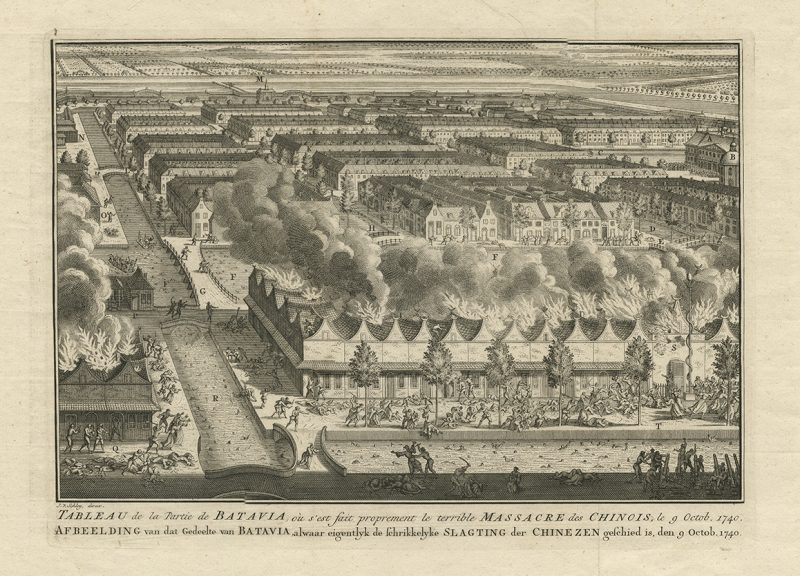
Antique Print Chinese Massacre by Van Schley (c.1740) titled ‘TABLEAU de la Partie de BATAVIA, ou s’est fait proprement le terrible MASSACRE des CHINOIS, le 9 Octob. 1740.
AFBEELDING van dat Gedeelte van BATAVIA, alwaar eigentlyk de fchrikkelyke SLAGTING der CHINZEN gefchied is, den 9 Octob. 1740′.
The rare mid-18th century print showing the terrible massacre of the Chinese that occurred in Batavia October 9th 1740, engraved by Adrian van der Laan of Amsterdam. The print shows Dutch troops firing cannon into Chinese houses on the banks of Kali Besar, slaughtering people as they fled their burning homes and waiting in boats to kill those that sought escape in the river; it is estimated that some 10,000 Chinese were killed. The massacre was prompted by tales of Chinese atrocities following the death of 50 Dutch soldiers at the hands of enraged Chinese sugar plantation workers who were protesting about Government repression and the declining sugar prices.
The 1740 Batavia massacre (Dutch: Chinezenmoord, literally “Murder of the Chinese”; Indonesian: Geger Pacinan, meaning “Chinatown Tumult”) was a pogrom of ethnic Chinese in the port city of Batavia (present-day Jakarta) in the Dutch East Indies. The violence inside the city lasted from 9 October until 22 October 1740, with minor skirmishes outside the walls continuing late into November that year. Historians have estimated that at least 10,000 ethnic Chinese were massacred; just 600 to 3,000 are believed to have survived.
During the early years of the Dutch colonisation of the East Indies, many people of Chinese descent were contracted as skilled artisans in the construction of Batavia on the northwestern coast of Java. They also served as traders, sugar mill workers, and shopkeepers.The economic boom, precipitated by trade between the East Indies and China via the port of Batavia, increased Chinese immigration to Java. The number of ethnic Chinese in Batavia grew rapidly, reaching a total of over a 10,000 by 1740. Thousands more lived outside the city walls.
The Dutch colonials required them to carry registration papers, and deported those who did not comply back to China – the policy was tightened during the 1730s, after an outbreak of malaria killed thousands. The outbreak was followed by increased suspicion and resentment in native Indonesians and the Dutch toward the ethnic Chinese, who were growing in number and whose wealth was increasingly visible.
Wealthy Chinese were extorted by corrupt Dutch officials who threatened them with deportation, and there were rumours that deportees were not taken to their destinations but instead thrown overboard once out of sight of Java. In some accounts, they died when rioting on the ships. The deportation of ethnic Chinese caused unrest among the remaining Chinese, leading many Chinese workers to desert their jobs.
At the same time, due to economic imbalance, native occupants of Batavia became increasingly distrustful of the Chinese. Most natives were poor, and they perceived the Chinese as occupying some of the most prosperous neighbourhoods in the city. The actual situation was more complicated. Many poor Chinese living in the area around Batavia were sugar mill workers who felt equally exploited by the Dutch and Chinese elites who owned the mills. The price of sugar, however, was set by the Dutch overlords set the price for sugar, which itself caused unrest.
In the 1720s, due to an increase of exports to Europe and competitions from the West Indies, worldwide sugar prices declined and the sugar industry in the East Indies suffered considerably. By 1740, prices had dropped to half the price in 1720. As sugar was a major export, this caused considerable financial difficulties for the colony and led to further unrest.
Despite oppositions from the Dutch Council of the Indies, who did not believe the Chinese would ever attack Batavia, governor-general Valckenier called up an emergency meeting of the council in September, during which he gave orders to respond to any ethnic Chinese uprisings with deadly force. This policy continued to be opposed by his political opponent, van Imhoff.
Vermeulen (1938) suggested that the tension between the two colonial factions played a role in the ensuing massacre.
Events leading to the Massacre of October 1740
On the evening of the 1st of October, a crowd of a thousand Chinese had gathered outside the city gate, angered by Valckenier’s statements at the emergency meeting five days earlier. This was initially received incredulously by Valckenier and the council, but when a Balinese sergeant was murdered by the Chinese outside the walls, the council decided to take extraordinary measures and reinforce the guard.
On the 7th of October, hundreds of Chinese sugar mill workers revolted using custom-made weapons to loot and burn mills, and killed 50 Dutch soldiers in Meester Cornelis (now Jatinegara) and Tanah Abang. In response, the Dutch sent 1,800 regular troops, accompanied by schutterij (militia) and eleven battalions of conscripts; they established a curfew and cancelled plans for a Chinese festival. Those inside the city walls were forbidden to light candles and were forced to surrender everything “down to the smallest kitchen knife”.
- An original antique sheet, not a reproduction
- The actual piece is photographed
- Certificate of authenticity on request
- Viewing in Jakarta by appointment